
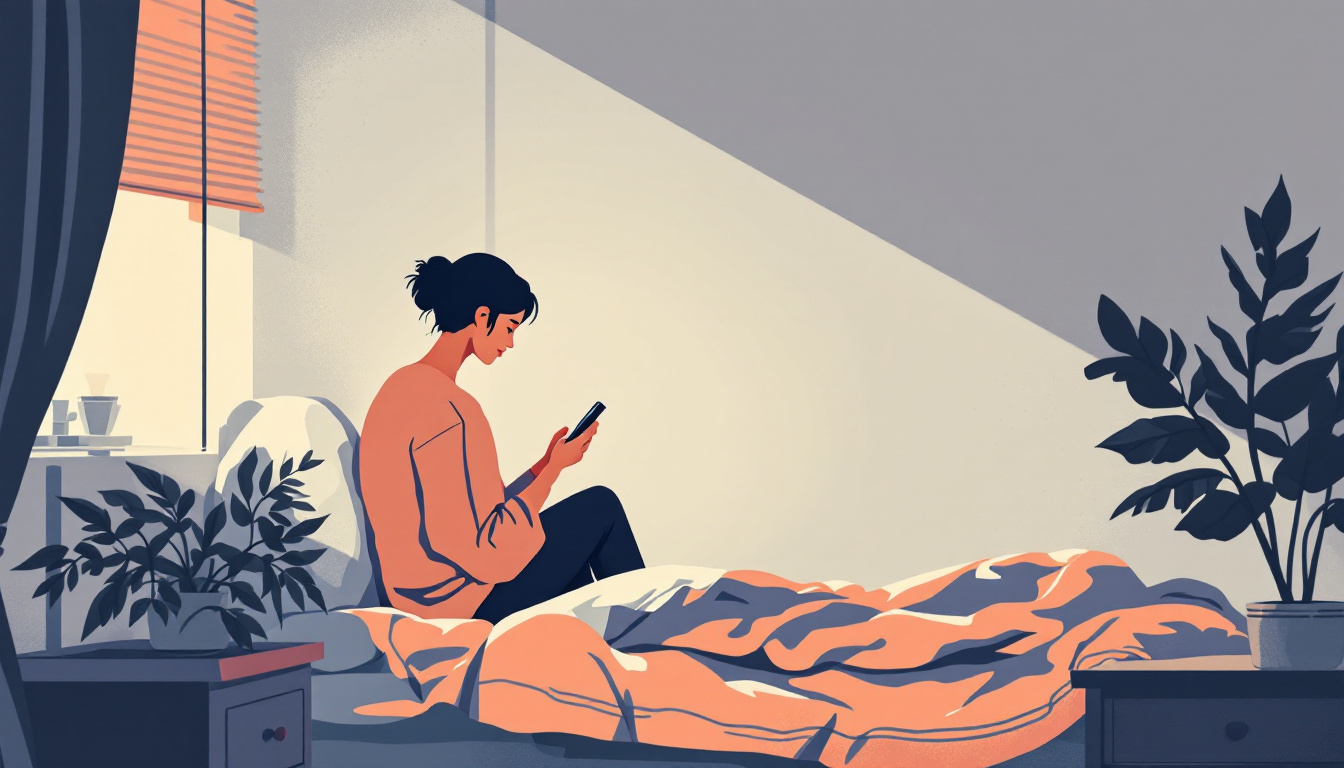
It's 1am and you're scrolling an ex's photos again. Not your ex: theirs. You told yourself you'd stop after one more, and forty minutes later you're running a mental movie of your partner with someone else, filling in details you don't actually have. Maybe you already know the story (they mentioned a name once, months ago) and your brain has been quietly building a whole relationship out of that one sentence ever since. It doesn't matter that it's over, or that you weren't there. It feels current, urgent, like something you need to solve tonight.
That's retroactive jealousy: jealousy aimed at your partner's past instead of their present. It's real and exhausting, and if you're mid-spiral reading this at 1am, you don't need a definition. You need somewhere to put your hands right now.
First: the next five minutes
Your body is treating this like a live threat, which makes clear thinking almost impossible. Start with the body, not the story.
Settle down first. A few minutes of slow, exhale-focused breathing (long inhale, longer exhale) brings the physical alarm down before you try to reason with anything. You don't need a full routine at 1am, just enough to unclench your chest.
Name what actually triggered it. Not "I'm jealous of their past," but the specific thing: a photo from three years ago, a name you'd never heard before. Vague jealousy can eat an entire evening. A named trigger is something you can actually look at.
Now, the hard part: stop the digging. Checking their exes' profiles, asking questions you already know the answers to, rebuilding a timeline you don't need: none of that is research, it's the engine of the loop. In a study of people going through exactly this, the "detective work" (searching, comparing, checking) never once made a participant feel closer to their partner afterward (Frampton & Fox, 2018, Social Media + Society). Not sometimes. Zero. It doesn't resolve the feeling, it feeds it, and then it wants more. Close the tab. The photos aren't going anywhere; the urge to check one more time will still be there in the morning, and it'll still be a bad idea then too.
If you're mid-conversation with your partner and the questions are climbing, it's fair to say out loud: "I need to stop asking about this tonight, it's not helping either of us." That's not avoidance. It's declining to feed the one behavior the research showed helps nobody.
Why your brain does this
Two things are happening at once. Uncertainty about someone you're attached to gets processed by your brain as a threat, even when the "threat" is a decade in the past and already resolved. Your nervous system doesn't have a setting for "this used to matter." And comparison does the rest of the damage: measuring yourself against someone who exists only as a curated photo or a story you half-know is a fight you can't win, because you're comparing your full, complicated self to a highlight reel (Frampton & Fox, 2018).
People who've lived this describe it accurately: a compulsion to know more about the past, a feeling of being split between the part of them that wants to stop and the part that can't, and a clear awareness the whole time that the questioning is hurting the relationship (Blayney & Burgess, 2023, Counselling and Psychotherapy Research). That's worth sitting with. This usually isn't a lack of insight; most people in this loop already know it isn't helping. Knowing that and being able to stop are different skills, and the second one takes practice, not willpower at 1am.
One thing worth naming clearly: retroactive jealousy is a real, well-described experience, not a diagnosis. You'll see it called "retroactive jealousy OCD" online. That's an informal label for how compulsive it can feel, not a clinical category, and it's not something this article, or anyone without a license, can tell you that you have. What it's called matters less than what you do about it tonight.
Longer-term: spotting the loop before it starts
You won't out-think this in one good night. Willpower is a bad plan for 1am; a habit built in daylight is a much better bet. What actually shifts things over weeks:
- Learn your specific openers. For most people it's not "their past" in general, it's two or three recurring triggers: a certain photo, a specific name, a particular kind of story. Know yours, and you can catch the loop at step one instead of step fifteen.
- Build the "don't dig" habit when it's calm, and use it later. Decide in advance, outside of any spiral, that searching and checking are off the table. Deciding this now is far easier than deciding it at 1am, mid-urge. Then, when the "I know this is hurting us" thought shows up, treat it as the signal to stop, not something to push past for one more answer.
- Give the past its own conversation, once, on purpose. If there's something you genuinely need to hear from your partner, that's a calm, daylight conversation to have once, not something to reopen in fragments at midnight.
When this is beyond an article
If these thoughts have an intrusive, compulsive, "I can't not think about this" quality: if the checking won't stop even when you want it to, or it's costing you sleep or your sense of yourself, bring in a licensed professional rather than manage it alone. If it has that compulsive shape, the International OCD Foundation is a solid, honest place to start reading, not as a diagnosis, but because they take it seriously without dismissing or overselling it. An article can hand you something to try tonight. It can't know your whole history.
Where the app fits
This is, step for step, what Don't Spiral is built for. If you're mid-spiral right now, open the app and tell it what you found: it settles your body first, then helps you sort what actually happened from the story your anxiety is telling about it. If what's underneath is a bigger, quieter question, not what happened years ago but whether it should still matter this much, say that instead; it recognizes the difference and sits with the doubt honestly, without rushing you toward a verdict. It won't hand you a ruling on your partner's past; that was never the job. Open it now, and let it walk you through the next few minutes instead of doing this alone.